Why We Believe Imaginary Worlds
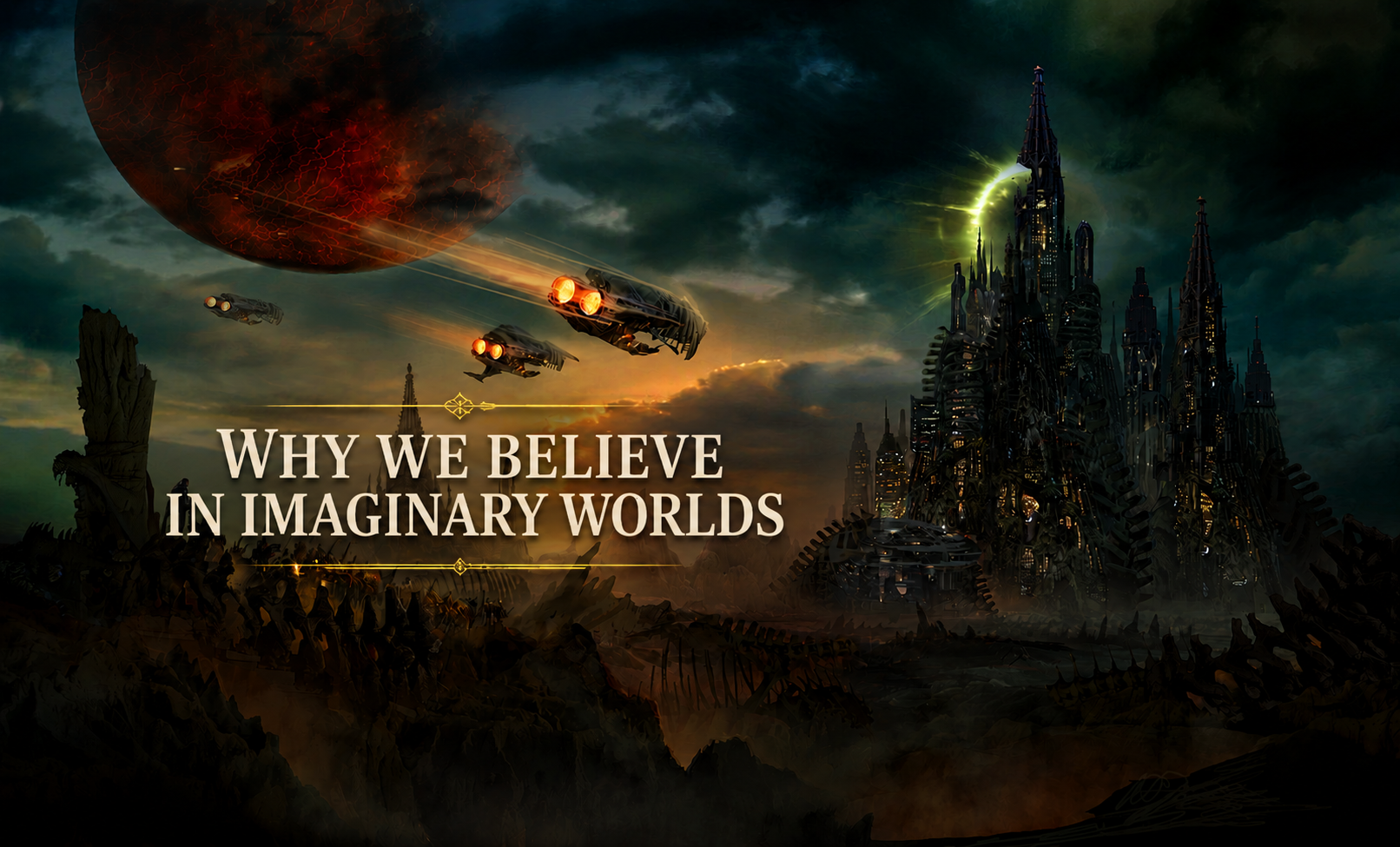
The most believable imaginary worlds don't feel invented. They feel discovered.
At first glance, that sounds impossible. Imaginary worlds are, by definition, invented. Someone has to imagine the creatures, design the architecture, write the history, and decide how everything works. For much of my career, I believed that imagination was the primary ingredient of worldbuilding. Then I had the opportunity to help build worlds like Middle-earth, Wakanda, and many others, and I began noticing something unexpected.
The worlds audiences fall deepest into aren't simply collections of imaginative ideas. They feel as though they existed long before the story began. Every creature appears shaped by its environment. Every building reflects the people who constructed it. Every culture carries the weight of its own history. Nothing feels as though it was placed there for the audience. Everything feels as though it belongs.
That realization completely changed the way I approached worldbuilding. Ironically, I discovered that creating more believable imaginary worlds had less to do with escaping reality and more to do with understanding it.
The more I studied biology, architecture, anthropology, history, engineering, and ecology, the richer my fictional worlds became. Not because those disciplines gave me more things to copy, but because they taught me how relationships shape everything around us. One phrase I've repeated to artists throughout my career is: "The environment is a character too." People often assume I mean that environments deserve as much artistic attention as the cast. They do—but that's only part of what I mean.
The environment isn't simply another character. It creates the characters.
Every civilization is shaped by the world it inhabits. Geography determines available resources. Resources influence technology. Technology shapes architecture. Architecture influences how communities gather, defend themselves, worship, and trade. Over generations, those practical decisions become traditions, beliefs, and culture.
Long before the story begins, the world has already begun creating the people who live within it.
Once I began seeing that relationship, the questions I asked changed. I stopped asking what something should look like. I started asking why it existed.
During both Shadow of Mordor and Black Panther, my worldbuilding artists eventually learned there was one question they could almost guarantee I was going to ask whenever they presented a design: "Tell me why."
Why this material? Why this shape? Why would this civilization solve the problem this way? What constraints led to this decision?
Eventually, "Tell me why" became something of a catchphrase on the team. Looking back, I don't think I was really asking about the design itself. I was trying to teach a way of thinking. Too often, artists become focused on the assignment directly in front of them. I wanted my teams to understand that every decision they made became part of a much larger experience. Every object, creature, building, and visual detail either strengthened the audience's belief in the world or weakened it. My goal wasn't simply to improve individual assets; it was to help people understand how their work contributed to the larger experience we were creating together.
I wasn't looking for justification. I was encouraging curiosity.
Because every believable design is usually the consequence of something else. A roofline exists because of heavy snowfall. A settlement grows beside fresh water. A decorative pattern survives because it began as a structural solution generations earlier, while a weapon may reveal more about a civilization's metallurgy than it does about warfare.
The deeper you ask why, the less arbitrary the world becomes.
I've found that principle extends far beyond architecture. When I design a creature, I rarely begin with its appearance. Instead, I ask where it lives, what it eats, what hunts it, how it moves, and how its environment has shaped it over thousands of generations. Once those questions have been answered, the creature often begins designing itself. The same is true for civilizations. I don't begin with style.
I begin with relationships.
Over time, I realized something even more important. The greatest reward of worldbuilding isn't invention. It's discovery.
The more I studied ecosystems, architecture, engineering, anthropology, and history, the more ideas I found—not because I was collecting references, but because I was learning how systems behave. Every ecosystem solves different problems. Every civilization responds to different constraints. Every architectural movement reflects the geography, technology, available materials, and beliefs of the people who created it.
Eventually, you stop seeing appearances. You begin seeing principles.
Those principles become the foundation of imagination. Some of my favorite architectural styles weren't born from trying to invent something no one had ever seen before. They emerged from understanding why real architectural movements evolved in the first place. Once I understood the relationships between geography, engineering, available materials, and culture, I could begin recombining those principles into something entirely new.
The result wasn't history. It was believable fiction.
Perhaps that's why artists have always been encouraged to travel, study different cultures, and remain endlessly curious. Not because those experiences simply give us more interesting things to paint, but because every experience expands the number of relationships our minds can make. Every landscape, every conversation, every culture, every book, every success, and every failure.
Over time, those experiences begin connecting in unexpected ways. What we often call imagination is really the synthesis of a lifetime spent paying attention.
That realization eventually changed the way I thought about leadership as well. One observation I've made over the years is that many people stop thinking once they've solved the immediate assignment. They know what they're building, but rarely ask why it belongs in the world at all.
I wanted my teams to think differently. Not because I expected everyone to become an architect or an ecologist, but because I wanted every artist to understand that their work wasn't an isolated asset. It was one contribution to a much larger experience. The better each person understood how their work connected to everything around it, the stronger the world became.
In many ways, "Tell me why" was never really about worldbuilding. It was about teaching people to think in relationships. Because richer relationships create richer worlds. And richer worlds create deeper immersion.
Ultimately, immersion is the goal, and believability is the bridge that leads us there. When every part of a world feels connected, the audience stops seeing design. They stop thinking about production schedules, individual assets, or the thousands of creative decisions that made the experience possible.
Instead, they simply believe they've been somewhere else.
Looking back, I don't think I've spent my career inventing worlds. I've spent it discovering why they work.
And perhaps that's the real paradox of imagination.
The more deeply we understand the real world, the more believable the imaginary ones become.
