I've been thinking a lot about why I create.
Not what I create, or even how I create, but what has quietly driven me through more than thirty years of making art.
As my career progressed, something unexpected began to happen. The further I moved beyond creating individual illustrations and into art direction, worldbuilding, and creative leadership, the less I found myself thinking about any single discipline in isolation. Instead, I became increasingly fascinated by how all of them worked together.
Over time, my perspective widened. I stopped seeing digital painting, music, editing, performance, writing, and cinematography as separate crafts and began seeing them as parts of the same expressive system. Each discipline contributed something unique, but they all seemed to be working toward the same goal.
That goal was to create an emotional response.
Looking back, I think that's what has always driven me creatively. I love making things that make people feel something. The tools have changed throughout my career. The scale of the projects has changed. My responsibilities have changed. But that underlying fascination has remained remarkably consistent.
It seems obvious to me now, but it certainly wasn't obvious at the time. In fact, I don't remember many people talking about creativity this way. The more I thought about it, the more I realized that what looked on paper like a standard climb up the corporate art ladder was really an education in how all those disciplines collaborate.
Once I started seeing the relationships between those disciplines, the illusion of separation vanished. And I realized then, what I'd really been building was an interconnected system of communication.
The Illusion of Separation
Every creative discipline communicates, although we don't often stop to think about it that way. Music communicates. Editing communicates. Lighting communicates. Even silence communicates. Each discipline contributes a different frequency, but they're all participating in the same conversation.
At first glance, that doesn't sound particularly profound. Of course, artists communicate! That's what art has always done, right?
What I've found increasingly interesting is where we decide to place our attention as creators. More specifically, how we create visual and emotional hierarchy to guide our viewers.
Much of our education and critique focuses on technique. We spend years learning perspective, anatomy, composition, sound design, and animation. Mastery matters, and achieving it is an incredible accomplishment. But somewhere along the way, I began to suspect that technique isn't really the destination.
Technique is simply the language. Communication is the purpose. Emotion is the result.
If you strip away all the terminology, I think creators are really trying to accomplish two things.
Help people understand what deserves their attention. (What are we, as visual artists, guiding our audience to look at?) Help people experience something emotionally. (What do we want them to feel?)
In many ways—and I've shared this with team members and friends consistently for years—we're essentially speaking directly to the ancient animal brain. We're targeting the amygdala. Those deep, subcortical areas are responsible for primal drives, demonstrating that art registers at a fundamental, visceral level.
Artists rarely describe it that way, of course.
We simply say... We want someone to laugh. Or cry. Or feel wonder. Or hope.
And in team environments, every single discipline contributes to that hit. When all the sensory elements are working in harmony, the result is incredibly powerful.
Years ago, I started distilling these thoughts for my teams and students into a simple phrase.
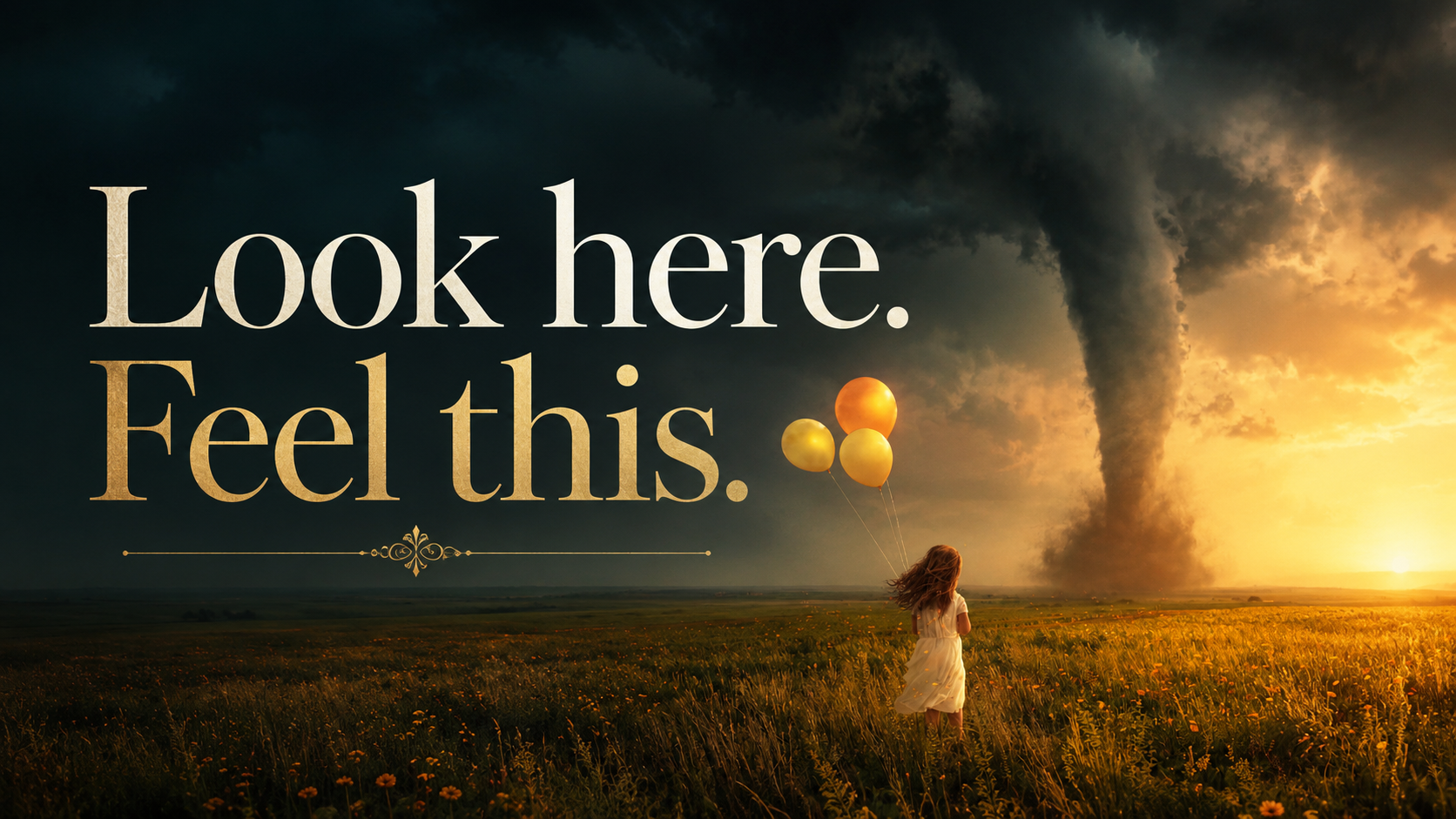
"Our job is to help people know where to look and what to feel."
At the time, it was simply a directing note. It seemed almost too obvious to be worth saying. The older I get, however, the more I realize how easily we lose sight of it.
The Machinery and the Ego
Working in games, I can’t tell you how many creators and entire teams I watched lose sight of this.
People become consumed by their own disciplines. Or worse, they get caught up in the sheer complexity of the technology itself. They fall in love with the new widget they engineered, rather than what that widget is actually supposed to do to the audience.
And look, artists are just as guilty of this. We fall right into the ego trap. I can't count the number of times I've seen a concept artist—or caught myself—spending forty hours rendering hyper-realistic, intricate scrollwork on a character's armor, completely distracting the viewer from the character's actual expression. We prioritize showing off our technique over communicating the emotion. We prioritize "Look at how good I am" over "Look here, feel this."
What we often forget is that our most powerful tool for guiding focus is omission. The hardest part of "Look here" is having the discipline to say, "Do not look at anything else." It takes courage to mute a track, cut a line of dialogue, or cast half a beautifully rendered painting in shadow.
Because here's the funny thing about mastering all this technique: when it works perfectly, it disappears. When every discipline aligns, the audience stops seeing brushstrokes. They stop hearing a sound mix. They forget they are holding a controller or looking at a screen. The machinery vanishes.
Then comes the data trap. I have seen incredibly talented teams get so buried in analytics, user testing, market analysis, and consumer feedback that they completely forget the fundamental goal. They optimize the metrics but lose the magic. They forget that, at the end of the day, all of us are just trying to create a memorable emotional experience.
That experience doesn't just live in sweeping cinematic cutscenes. It lives in the micro-moments.
It's that split-second rush of victory when a player triggers a powerful ability, and the animation, the game mechanic, the UI, and the character design all fire in perfect unison to make them feel unstoppable.
It's the spatial psychology of traversing a landscape—the distinct, visceral awe a player feels when they finally step out of a dark, claustrophobic cave and are suddenly hit with a massive, sunlit environmental reveal.
That reaction isn't an accident. It's evolutionary. Humans are natural explorers. We're wired to seek out that exact sense of discovery in real life because it hits our deepest biological reward centers. What is over that cliff? What is beyond that hill? What is waiting outside the enclosure of the forest canopy?
None of those moments happen by accident. And they don't happen in isolation.
I remember conversations where colleagues would confidently say, "Gameplay is king." They weren't wrong. But I always found myself thinking that gameplay isn't important because it's gameplay. Gameplay is important because of how it makes the player feel.
When people say a game is "fun," they're describing an emotion, not a mechanic. The mechanic is simply one of many tools guiding the player toward that emotional experience.
Truth is, some of my developer friends probably thought I was getting a little too artsy with all my talk about feelings and where the player's attention should go. In fact, I know they did—they teased me about it pretty often. After all... I was the art guy.
But that was exactly why I couldn't stay in my lane. I was always poking my nose into areas outside my job description—asking about audio cues, questioning the pacing of a level, or digging into the narrative design. Not to overstep, but because I realized early on that if the audio or the mechanics fought the visuals, the entire emotional payload collapsed.
Looking back, I know I was describing something much larger. As an illustrator, I was constantly thinking about where the viewer's eye would land first. If everything in a painting carried the same visual weight, the image became harder to read. Years later, as an art director, I realized exactly the same principle applied to an entire game.
Every discipline was communicating with the player at the exact same time. If they weren't aligned, the experience became noisy.
If the story conflicted with the visuals... If the gameplay conflicted with the fantasy... If the music fought the performance... Something always felt slightly off, even if every individual discipline was doing excellent work.
Holding All the Tools
Ultimately, that realization became the catalyst for a massive shift in my own career. I needed to know what would happen if I stepped away from the multi-million-dollar AAA machinery to build my own intellectual property. I wanted to see what was possible if I removed the committees, the focus groups, and the analytics, and just fiercely protected the emotional core of a project from day one.
More recently, stepping out on my own to build these original animated films has brought that realization into even sharper focus.
For the first time in my career, I'm responsible for many of those creative disciplines myself. Instead of directing specialists across different departments, I am holding the tools simultaneously—moving back and forth in real-time between composing the music, digitally painting the assets, editing the timeline, and shaping the pacing for an 18-minute animated pilot I'm currently building.
That experience has been unexpectedly revealing. When you're the one personally balancing the heavy, stoic physical weight of a giant against the pure, tiny optimism of an innocent companion, you realize just how fragile the creative ecosystem is.
Every single decision influences every other decision.
A camera move isn't simply movement. It's emphasis. When I drop a sweeping cinematic chord into the audio track, it’s not there because silence feels empty. It has to perfectly match the visual exhaustion in a giant’s bones. And when a tiny, innocent character finally speaks, I realize I don't need a page of complex narrative prose to explain her to the audience. A beautifully paced glance and a single line of dialogue as simple as "I love to dream" communicates more than a heavy exposition dump ever could.
It also does something essential: it leaves room. While it's our job to use our talent and intent to guide the viewer, we can never dictate every detail. The audience is always the final collaborator. When you carefully pace a quiet moment, you aren't just handing them an emotion. You're creating a space for them to bring their own lived experiences, their own nostalgia, and their own longing into the scene.
But I won't pretend this process is seamless. In reality, holding all of these disciplines at once is incredibly chaotic.
It's also terrifyingly exposing. In a massive studio environment, if a moment falls flat, you can blame the schedule, the committee, or a bad game mechanic. When you step out to build a project completely on your own, you strip away all of your excuses. There is nowhere to hide. If the audience doesn't feel anything when a character speaks or a landscape is revealed, the failure rests entirely on your shoulders.
When you're jumping back and forth between a digital painting canvas, a sprawling video timeline, and a massive audio mix, the sheer volume of creative variables can be paralyzing. It's surprisingly easy to drown in your own production pipeline. You can spend hours tweaking a shadow, adjusting a render, or equalizing a sound effect, only to step back and realize you’ve completely suffocated the scene.
That's exactly when I have to fall back on the anchor. When the timeline gets too noisy, or I lose the thread of what a moment is actually supposed to be, I stop looking at the mechanics and ask myself the only question that matters.
The more disciplines I find myself holding at once, the louder this simple philosophy becomes.
Everything is communicating.
Looking back, I can finally see the thread that connects my entire path. From painting single illustrations, to directing massive AAA art teams, to pacing my own independent films, I haven't really been changing professions. I was just steadily widening my lens, getting my hands on more of the tools required to communicate with another human being.
The tools changed. The mediums changed. Technology certainly changed.
The purpose never did.
Maybe that's why one simple phrase has stayed with me for so many years.
Look here. Feel this.
