The Invisible Cost of Misunderstanding
The Real Problem Wasn't Better Ideas
Like many people, I initially believed the answer was better ideas. If we could define a stronger vision, generate better concepts, or solve difficult creative problems more frequently, the project would naturally improve. Certainly, good ideas mattered. But over time, I began noticing that most struggling teams weren't suffering from a lack of good ideas.
They were suffering from something far less obvious: they didn't share the same understanding of what they were trying to accomplish.
Misunderstanding Is Invisible
That misunderstanding was rarely visible. People attended the same meetings. They listened to the same presentations. They reviewed the same documents. Everyone left believing they understood the plan.
Then the work began.
Weeks later, subtle differences started appearing even amidst regular check-ins. Months later, those differences had become significant. Not because people ignored the vision, but because each person had unknowingly interpreted it through a different set of assumptions.
Communication Isn't Understanding
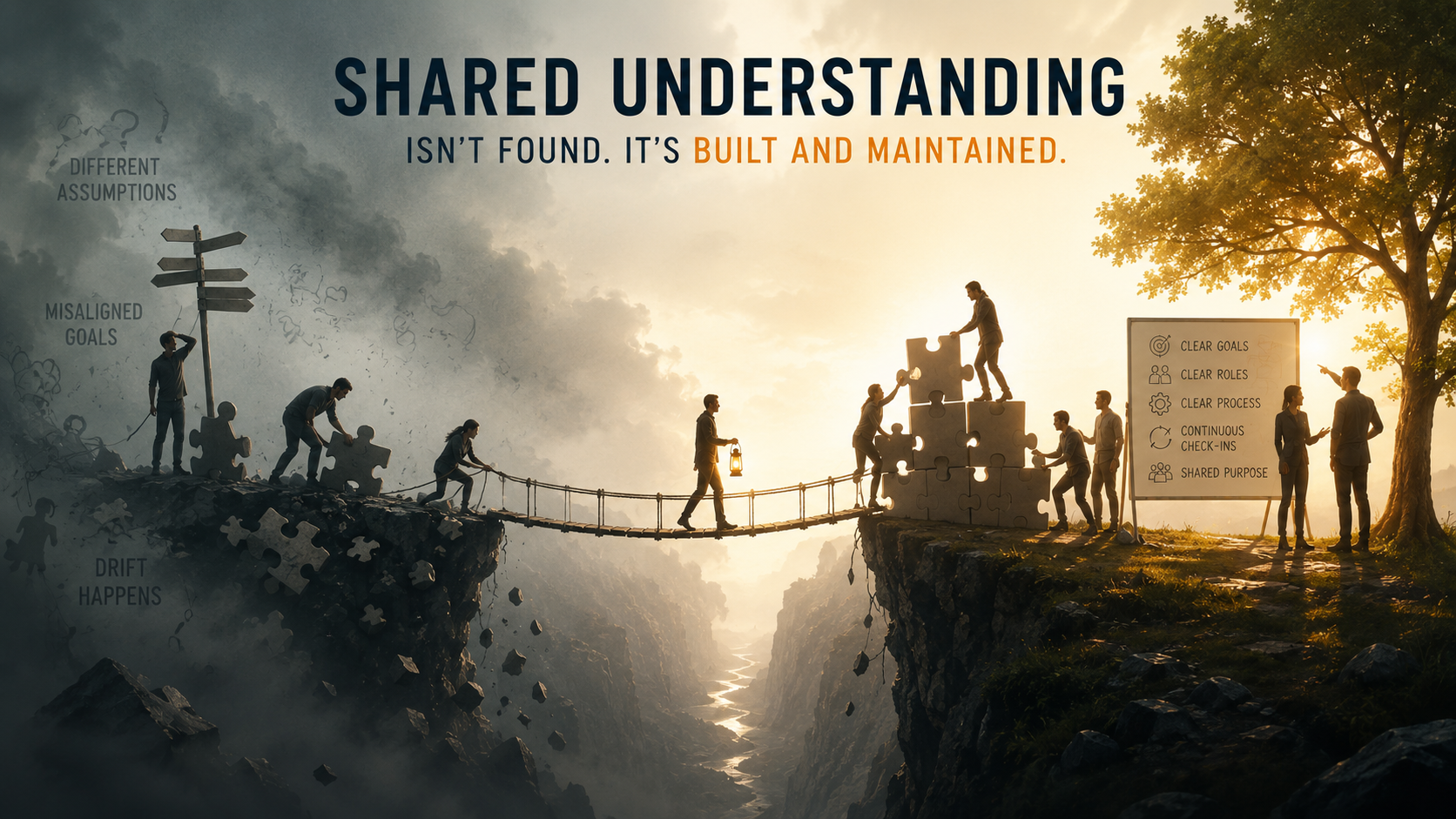
That was the first important lesson. Communication and understanding are not the same thing. Communication is something we do. Understanding is something we build. One does not guarantee the other. Shared understanding is not a byproduct of collaboration; it is the product of deliberate, structured maintenance.
Shared understanding also depends on something many organizations overlook: every discipline must understand how it contributes to the larger experience the team is trying to create.
Today's products have become too complex for any single discipline to fully define the experience.. Every discipline contributes something essential to the final experience. When goals are framed through only one lens, the rest of the team gradually shifts from contributing insight to executing instructions.
Consumers never experience departments.
They experience the whole.
Shared understanding begins when every discipline understands not only its own role, but how its expertise shapes the experience the team is trying to create together.
Alignment Naturally Degrades
As I continued observing teams, another pattern emerged. Most organizations treated alignment as something that happened heavily at the beginning of a project or milestone. Goals were established. Roles were assigned. Responsibilities were discussed. The vision was presented. Everyone nodded, and then everyone went to work.
The assumption was that alignment had been achieved. In reality, alignment had only begun.
Because understanding doesn't remain fixed. It changes. Priorities shift. New information appears. People join the team, and others leave. Departments learn new things, assumptions evolve, and memory fades. Without anyone intending it, a team's shared understanding slowly begins to drift.
I eventually stopped thinking about alignment as something you create, and began thinking about it as something you maintain.
Participation Isn't Alignment
That distinction changed the way I approached leadership. If understanding naturally degrades over time, then leadership cannot simply establish alignment. Leadership must continually help restore it.
This also explained why so many meetings accomplished less than everyone expected. Teams often confused participation with understanding. Everyone had been invited, everyone had heard the discussion, and everyone had an opportunity to speak. Therefore, everyone must be aligned.
But participation isn't evidence of understanding. Neither is agreement.
I've sat in countless meetings where everyone agreed upon the goal, the process, and the success criteria. The meeting ended, and everyone believed they had clarity. Months later, slowly but surely, it became obvious that each discipline had built toward a different definition of the goal and success criteria. Sometimes it was subtle but, other times more glaring. As an example, the engineers had built for flawless, invisible efficiency, while the designers had built for disruptive, high-friction visual novelty.
The team agreed on the language. It never agreed on the meaning.
Maintenance Prevents Drift
The solution wasn't more meetings. It was better maintenance and more precise success criteria that captured all of the disciplines involved.
Where teams truly fail is in the application. We go to the effort of creating rules, goals, and processes, but we rarely reassert them. We spend an exorbitant amount of time building the foundation—drafting detailed design documents, tech specs, and comprehensive art bibles. Then, we assume that foundation will hold itself together. But people are busy. They get lost in the friction of their daily tasks and slowly lose sight of the overarching vision.
Human memory is fragile, and alignment requires repetition. To create a system that is constantly nurtured, every meaningful discussion must become an opportunity to rebuild that shared understanding. It requires a disciplined commitment to opening every review not by diving straight into the work, but by re-anchoring the room. It means consistently pausing to verify the core objective, examining whether our assumptions have shifted, and honestly evaluating if the work in front of us still reflects the original intent.
This sounds incredibly obvious, yet it is almost always the first practice teams abandon. We do it once or twice at the kickoff, assume alignment is locked, and stop. Soon after, the team finds itself trapped in massive meetings where no one remembers why they are even there or how they are supposed to contribute.
Reasserting the vision isn't repetitive. It is preventative. It is the daily discipline that stops small, natural misunderstandings from becoming expensive ones.
Clarity Enables Creativity
Roles and responsibilities turned out to be just as important. Many teams resisted defining them clearly because they worried structure would limit creativity and put people in a box. My experience was exactly the opposite.
Clear roles reduced confusion. When people understood how they are contributing, who they are working closely with, who is responsible for making decisions, who owns the work, how every discipline contributes to the larger objective, and where the hand-offs are, meetings became more productive. Creative energy shifted away from negotiating ownership and toward solving problems.
We don’t want our team members jockeying for position and ownership. We want to clear the noise of “who is in charge of what” out of the way as much as possible so team members can spend their brain power on making something amazing. Clarity didn't reduce creativity. It created the conditions that allowed creativity to flourish.
Meetings Have Different Jobs
The same principle applied to process. Not every meeting should serve the same purpose. Large meetings are excellent for communicating information, reviewing progress, and reinforcing shared objectives. They are far less effective at solving complex problems.
Problem-solving requires discussion. Discussion requires participation. Participation becomes increasingly difficult as groups become larger.
Understanding isn't improved simply because more people are in the room. Often, the opposite is true.
The Romance of Chaos
If all of this is so obvious, why does it keep happening? Why do rooms full of incredibly intelligent, experienced professionals repeat the exact same mistakes, project after project? We have the tools, the schedules, and the documents.
Yet we still drift.
Repeating the same actions while expecting a different outcome is the definition of insanity, but I think the reason we willingly repeat this cycle comes down to a deeply ingrained psychological bias: creative cultures secretly romanticize the chaos.
Every creative industry has its own version of the garage days. It is the myth of the scrappy team, pulling all-nighters, fueled by adrenaline and sheer willpower, barely holding it together until the final, magical moment where the project miraculously clicks. We stand in meetings and loudly declare that we hate crunch, yet deep in the DNA of our industries, especially among elder leaders who came up through those early days, there is a lingering, unspoken assumption that real art requires suffering.
We resist structure because we equate it with a loss of freedom. We refuse to consistently narrow the cone of focus because we mistakenly believe that keeping all our options open is what keeps the project innovative.
But total freedom isn't liberating; it is paralyzing.
When a team refuses to maintain shared understanding, they aren't protecting their creativity. They are choosing the adrenaline of a last-minute fire drill over the quiet, invisible discipline of daily maintenance.
Because putting out fires feels heroic, while maintenance just feels like work.
Misunderstanding Is an Entropy Problem
Looking back, I no longer believe misunderstanding is primarily a communication problem. I believe it's a maintenance problem.
Human beings naturally drift. Our assumptions drift. Our priorities drift. Our understanding drifts. Creative people often drift even faster because they are naturally drawn toward novelty, exploration, and new possibilities. This isn't a flaw to be managed; it is the very engine of the creative process.
It's simply part of being human.
The mistake is assuming shared understanding will remain intact without deliberate effort and consistent reinforcement.
Maintenance Is Not Bureaucracy
One concern I have whenever discussing process, roles, or clarity is that people assume I am advocating for more bureaucracy.
I'm not.
I'm advocating for maintenance.
Those are very different things.
Maintenance isn't about creating thicker design documents, adding more meetings, or slowing creative work with unnecessary process. In fact, I've found the opposite to be true. The purpose of maintenance is to remove friction before it has a chance to grow into confusion.
We already understand this principle in almost every other part of our lives. We don't expect to stay healthy because we exercised once. We don't expect a marriage to remain strong because we had one meaningful conversation years ago. We change the oil in our cars long before the engine fails. We brush our teeth every day, not because today's brushing produces dramatic results, but because small, consistent actions prevent much larger problems from appearing later.
Shared understanding works exactly the same way.
A few minutes spent at the beginning of a meeting reaffirming what success looks like, who owns which decisions, what assumptions have changed, and what everyone is trying to accomplish may feel repetitive in the moment. Compared to solving exciting creative problems, it can even feel mundane. But that small investment often prevents weeks or even months of unnecessary rework.
Maintenance is rarely exciting. Repair almost always is. That, I think, is why so many organizations unintentionally choose repair. Putting out fires feels heroic. Daily maintenance feels ordinary. Yet one quietly creates the conditions that allow exceptional work to happen, while the other simply responds after misunderstanding has already taken hold.
The irony is that the most creative teams I've worked with weren't the ones that resisted maintenance. They were the ones that embraced it. Because the less time they spent rediscovering what they were trying to accomplish, the more time they had to accomplish it.
Shared Understanding Is a Living System
Today, I think about leadership differently than I once did. Its purpose isn't simply to inspire people or help make smart, informed decisions. Its purpose is to continually maintain the conditions under which shared understanding can exist: clear goals, clear success criteria, clear roles, clear decision-making, clear process, continual reinforcement, and continual verification that the work still reflects the original intent.
Without those things, misunderstanding isn't surprising. It's inevitable.
Shared understanding isn't something we create once and then possess forever. It's much closer to a garden than a blueprint. Left unattended, it doesn't remain where we left it. It changes. Weeds appear. Priorities drift. Assumptions evolve. New people arrive. Old people leave. Without continual care, even the healthiest system gradually moves toward disorder.
Because the cost of misunderstanding is rarely small. Sometimes it's measured in missed opportunities, broken relationships, or failed products. Sometimes, it's catastrophic.
We can no longer afford to assume that understanding simply happens. We need to take a hard look at how we work together, constantly asking where unnecessary friction can be removed, and where clarity can be restored.
Shared understanding may never happen by accident, but it can happen by design. And if we learn to maintain it intentionally, exceptional teams will finally become as consistent as their talent always suggested they could be.
