Creativity Is Not A Gift
The Myth of the Creative Person
I don't believe creative people exist. At least not in the way we usually use the term.
We have created a strangely narrow definition of creativity. We associate it with painters, musicians, filmmakers, writers, designers, and other people whose creativity produces visible artifacts. Because their creativity is easier to see, we begin treating them as though they belong to a special category of human beings: creatives. I think we've mistaken creative expression for creativity itself.
Creativity doesn't belong to artists. It belongs to everyone.
Consider an accountant who insists they aren't creative. Perhaps they have never painted a picture or written a song in their life. Yet every day they take complicated systems of numbers and create logic from them. They recognize patterns, solve problems, organize information, and create clarity that didn't previously exist.
Creating clarity is a remarkably useful creative act.
Maybe that same accountant loves to cook or tends a garden. Maybe they know how to create a quiet evening for someone they love.
Once we stop looking only for art, creativity is everywhere.
Every human being imagines. Every human being makes connections, constructs meaning, and considers possibilities that don't yet exist. We even create stories about our own lives and then use those stories to interpret what happens to us. To some degree, what we call our reality is shaped by the story we continually tell ourselves about what our experiences mean.
I increasingly think creativity is a form of intelligence—one concerned not simply with understanding what is, but with imagining what could be.
Artists don't own that capacity.
Humans do.
The Beginning Is Wonder
If creativity doesn't begin with artistic ability, where does it begin?
I think it begins with wonder.
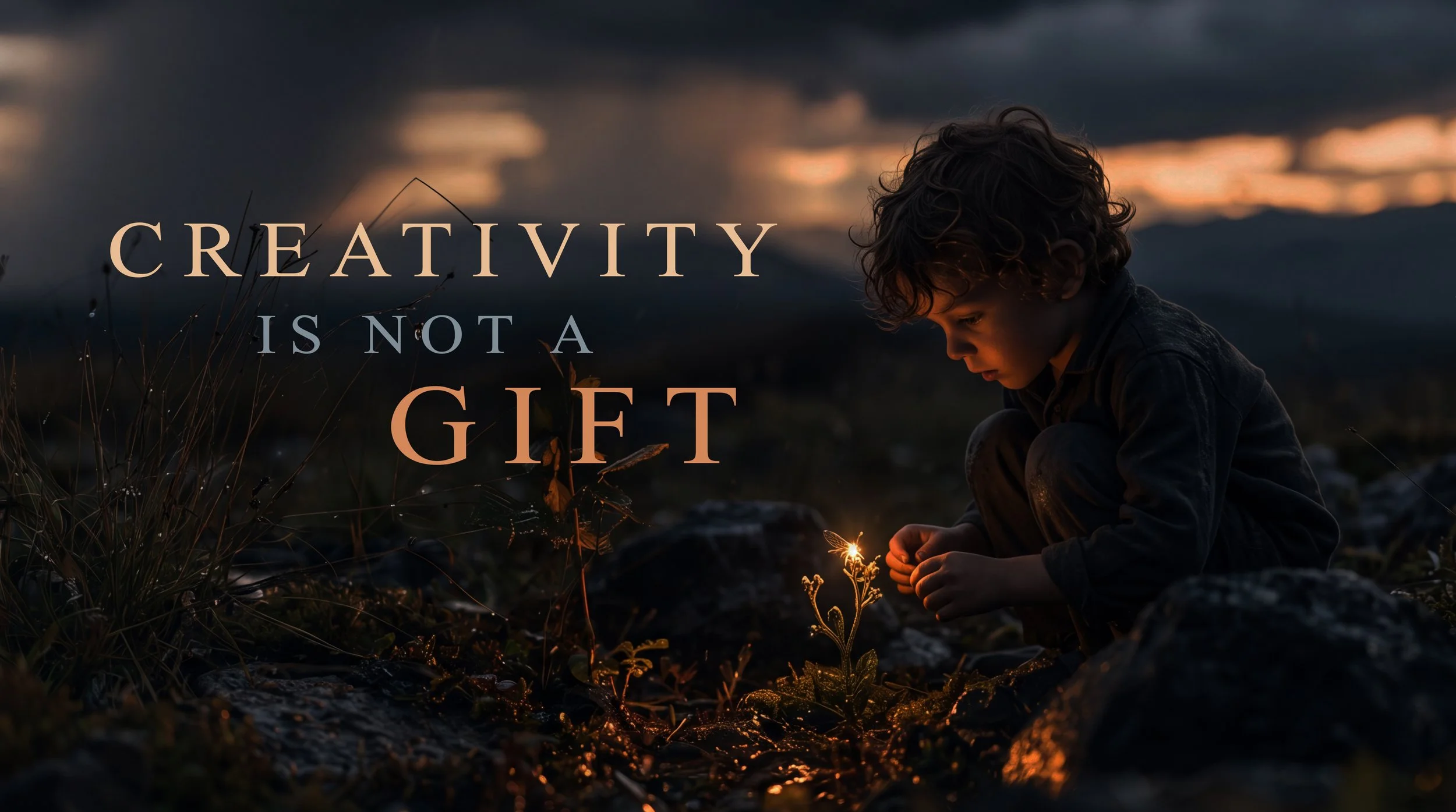
Watch children experience the world and creativity is everywhere. They explore. They experiment. They ask endless questions. They invent games. A stick becomes a sword. A cardboard box becomes a spaceship. An insect crawling across the sidewalk can stop an entire afternoon. Almost everything contains the possibility of discovery because almost everything is new.
As we grow older, something changes.
The hundred discoveries become fifty. Then ten. Then five. Eventually, entire days can pass without encountering anything that feels genuinely new. We develop routines. Predictability becomes necessary and, in many ways, desirable. But experience carries a hidden cost.
We've seen this before.
We've tried that before.
We know how this ends.
We become extraordinarily good at categorizing the world, and sometimes so efficient at recognizing what we've already seen that we stop looking closely enough to discover what we haven't.
Disappointment contributes to this too. By middle age, most of us have watched some of the same human cycles repeat several times. We've seen organizations make familiar mistakes, relationships follow familiar patterns, promises go unfulfilled, and ideas we believed in fail.
Experience gives us wisdom.
But it can also give us premature certainty.
Creativity pushes in the opposite direction. It asks us to remain curious about something after experience tells us we already understand it.
It asks:
What else could this be?
That question may be one of the ways adults recover something that children receive naturally: the possibility of discovery.
When Creativity Becomes an Identity
There is another problem with the way we define creativity.
Once we begin treating creativity as a special quality that some people possess and others don't, creative success can become evidence of talent. And creative failure can begin to feel like evidence of its absence.
I experienced this myself. Early in my career, I sometimes became physically nervous before beginning a painting. My stomach would tighten as I stared at the blank surface. I worried that I would spend several days creating something that wasn't good enough, wouldn't make my portfolio, and wouldn't move my career forward. Looking back, the anxiety wasn't really about the painting. I had connected the quality of the thing I was about to make to the quality of the person making it. If the painting failed, some part of me believed I had failed with it.
That's a dangerous equation.
Human beings clearly possess different genetic predispositions and natural abilities. Some people begin with extraordinary physical, cognitive, musical, spatial, or linguistic advantages. It would be foolish to pretend otherwise.
But a predisposition isn't mastery.
Whatever natural abilities we possess still have to be discovered, nurtured, challenged, and developed over a lifetime. Parents who give children the freedom to explore what naturally fascinates them increase the likelihood that those abilities will emerge. Curiosity encourages practice. Practice develops capability. Capability creates the possibility of mastery.
What we eventually call talent is often the visible result of a much longer process.
Drive feeds mastery.
Mastery is born from consistency.
The mythology of creativity as a gift can obscure that process because it places too much importance on what someone appears capable of doing today and not enough on what they might become tomorrow.
It took me years to understand that.
Creative Compounding
Eventually, I realized that not every painting I made needed to be exceptional. That sounds obvious to me now but, it didn’t then. If only one painting out of ten truly resonated with people, I could make twenty and perhaps two would. If I kept working long enough, eventually I would have a competitive portfolio. So I kept painting.
But something happened that my simple arithmetic hadn't accounted for. Painting number twenty wasn't created by the person who made painting number one.
The nineteen paintings in between had changed him.
Every painting had taught me something. Sometimes I learned what worked. Often, I learned what didn't. I became better at drawing, composition, color, storytelling, and observation. Eventually I became capable of recognizing weaknesses I previously wouldn't even have been able to see.
The work was accumulating.
But so was I.
That is what I have come to think of as creative compounding.
Every time we create, we produce two things: the thing we made and the person capable of making the next thing. The artifact may fail. The second outcome doesn't have to.
An unsuccessful painting can teach you something that makes the next ten paintings better. A failed experiment can eliminate an entire category of bad solutions. A creative dead end can expose a weakness you didn't know you had. Sometimes several days of work end up in the trash, but the understanding acquired during those days remains.
This means the equation isn't simply:
Ten attempts produce one success.
The attempts themselves change the probability of future success.
Attempt leads to experience. Experience, when examined, becomes learning. Learning increases capability. Increased capability changes the next attempt. And then the cycle begins again. The visible work is only one thing that's compounding.
The person is compounding too.
Failure Is Information
Failure still stings quite a bit. I can spend days trying to solve something, finally recognize that it will never work, and become deeply frustrated by the time I've lost.
What has changed is what that failure means to me. When I was younger, failure could mean:
Maybe I'm not good enough.
Today, it is much more likely to mean:
There's something here I don't understand yet.
That distinction has transformed my relationship with creativity.
We often talk about failure as though simply experiencing it makes us stronger. I don't think that's true. Failure is an opportunity for growth, but only if we remain curious enough to learn from it.
Two people can experience precisely the same failure and walk away with entirely different outcomes. One can use it as evidence that the world is unfair, the audience didn't understand them, the boss was wrong, or the idea was simply ahead of its time.
Another can ask:
What am I missing?
The failure is identical.
What changes is what happens next.
Through decades of working with creative people, I've watched enormously talented individuals stop developing while others continued growing far beyond what anyone initially expected of them. The difference was remarkably consistent.
The people who continued growing remained open.
They remained curious. They allowed new information to challenge old assumptions and were willing to consider solutions other than their own. They kept learning.
Experience by itself doesn't compound.
Processed experience does.
Someone can accumulate thirty years of experience while repeating essentially the same year thirty times. Growth requires allowing experience to alter us.
That is what turns failure into information.
And information into capability.
The Unknown Is the Reward
As my fear of failure diminished, something else happened. Learning became exciting again. That may sound strange, but I think I had slowly rediscovered something I knew instinctively as a child.
Discovery feels wonderful.
Today, when a creative session goes particularly well, I feel on top of the world. Certainly, some of that feeling comes from accomplishment and the satisfaction of a job well done. But there is something else there that has become increasingly familiar to me. It may be the closest I come as an adult to the joy of childhood discovery.
Creativity gives us the ability to encounter something we haven't seen before.
Sometimes I begin with a specific idea I want to express. Sometimes I'm trying to communicate an emotion. Other times I simply begin moving a pencil or digital brush and watch for something interesting to emerge.
Creativity is both invention and discovery and that's part of what makes it so exciting.
Imagination combines with research. Research collides with lived experience. Emotion changes the direction. Craft makes possibilities executable. One discovery reveals another relationship, which opens another possibility.
At its best, it can feel as though there is an answer to several questions somewhere just ahead of me. I can almost see it. If I keep moving toward it—working a little harder, thinking a little differently, looking a little more carefully—the pieces may suddenly connect. Then something exists that didn't exist before. Even if the discovery is only new to me, the experience of discovering it is real.
As children, the world creates unknowns for us. As adults, creativity allows us to create unknowns for ourselves.
Unknown Potential
This has changed the way I think about talent. The older I become, the less interested I am in asking whether someone is talented. I'm much more interested in what they might become.
I believe most of us live surprisingly close to abilities we haven't discovered yet. Not because human potential is literally unlimited. Biology, circumstance, opportunity, health, and time impose real boundaries on every life. But I don't think most of us actually know where those boundaries are. Too often, we stop exploring before we reach them. I'm not creative. I'm bad at this. I'm too old. That's not what I do. I've never been good at that.
Sometimes those conclusions are accurate assessments of where we are today. The mistake is assuming they accurately describe where we could eventually go.
Capability changes. The person attempting something for the hundredth time is not the person who attempted it for the first. We are continually changed by what we experience and what we practice. Sometimes years of effort seem to produce almost nothing until something clicks and we discover we've crossed a threshold we couldn't see while approaching it.
We are often closer to some unknown version of ourselves than we realize. The only way to meet that person is to keep exploring.
Creativity Is Not a Gift
I no longer think creativity is something bestowed upon a fortunate few.
I think it is something fundamentally human. It is our capacity to imagine what isn't there. To discover relationships. To create meaning. To solve problems. To take what exists and wonder what else it might become.
Some of us express that capacity through paintings or films. Others through equations, businesses, gardens, meals, relationships, inventions, stories, systems, or countless acts of creation so ordinary that we don't think to call them creative at all.
Perhaps the tragedy isn't that some people aren't creative. Perhaps it's that so many people have been taught not to recognize their creativity when they encounter it.
The child begins life surrounded by unknowns. Everything invites exploration. Everything contains possibility. Adulthood gradually teaches us what things are called, how things work, what we're good at, what we're bad at, what is practical, what is impossible, and what we're supposed to become.
Some of that knowledge is wisdom. But we should be careful not to let knowing what the world is extinguish our curiosity about what it could be.
I spent part of my early career afraid that a failed painting might tell me something about my ability. Decades later, I find myself almost grateful for the failures.
They taught me that the gift was never the point.
The discovery was.
The learning was.
The becoming was.
To create is not the privilege of a particular kind of person.
It is part of being human.
